

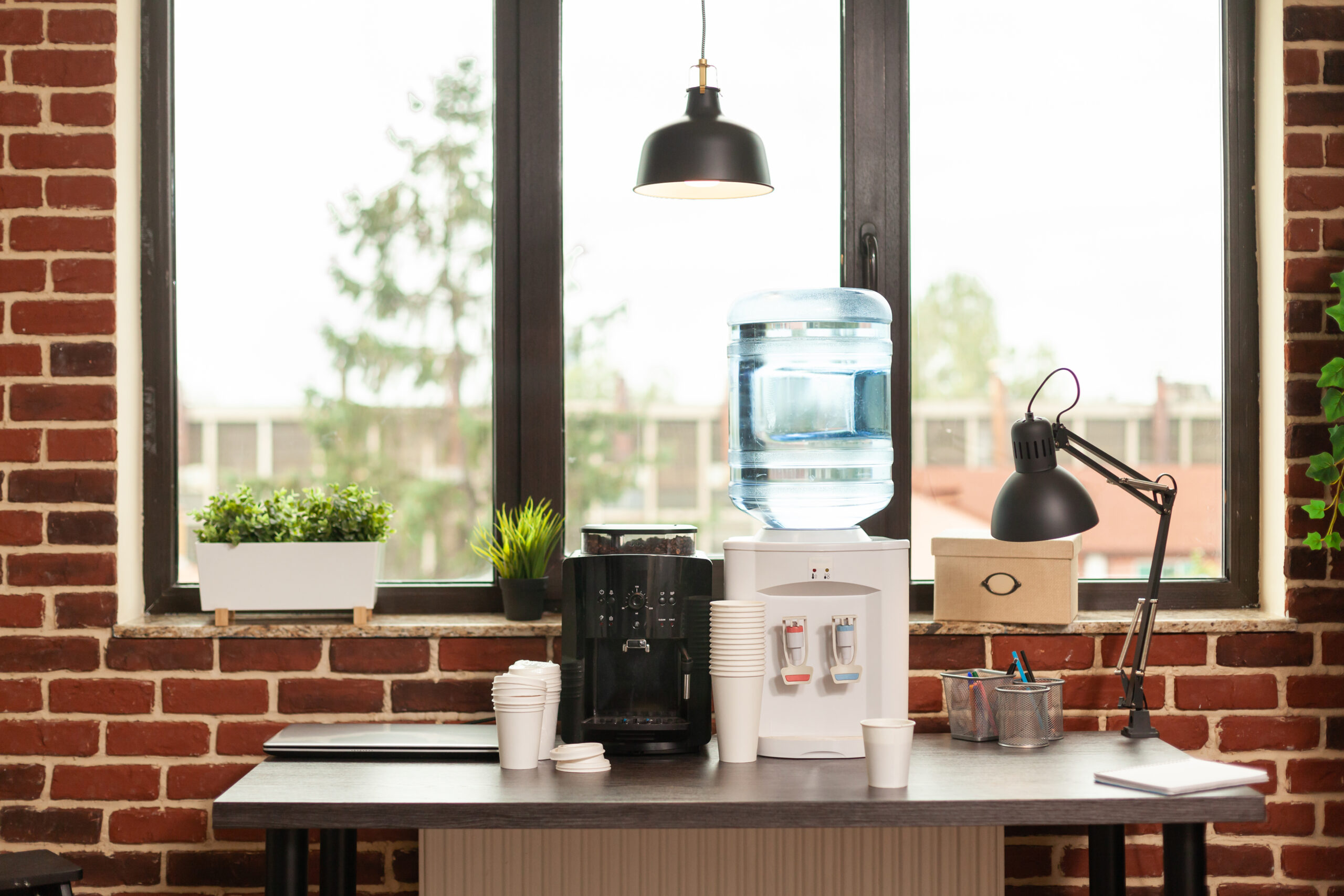
The office bin rarely looks alarming at 10 am.
A few coffee cups. Some lunch packaging. Two or three empty water bottles.
By the end of the day, the picture changes. Bottles appear beside desks, inside meeting rooms, around the pantry and in bins across the floor. Some are empty. Some are barely touched. Most disappear before anyone counts them.
That is why the question, how much plastic does a typical office use per year, is harder to answer than it first appears.
There is no useful “typical” number that fits every workplace. A 50-person hybrid office in Dubai does not operate like a 50-person call centre with two shifts. A client-facing company with daily meetings may use far more bottled water than a larger office where employees bring reusable bottles.
The most accurate answer is already inside your office. You simply need to measure it.
At Sprudel, we help UAE businesses understand their current bottled-water use before replacing it with practical on-site filtered water systems. Call +971 4 546 3988 or email hello@sprudel.life to discuss a water audit for your workplace.
Why Most Offices Underestimate Their Plastic Use
Bottled-water waste is spread across different areas and budgets.
Procurement sees the boxes of water ordered.
Facilities sees the storage.
Office administrators see the meeting-room supply.
Housekeeping sees the bins.
HR sees employees asking for better refill options.
ESG teams see the final sustainability report.
Because no single team sees the entire journey, the total often feels smaller than it really is.
A Dubai corporate office included in Sprudel’s sustainability material had been using more than 80,000 plastic bottles annually before installing filtered water systems across multiple office locations.
Your office may use far fewer. It may also use more than expected once visitors, events and half-finished bottles are included.
Let’s count properly.
The Five-Day UAE Office Waste Audit
You do not need expensive software or a consultant-led study to begin. Start with one normal working week.
Avoid choosing a public holiday week, an unusually quiet period or a major company event. The goal is to understand regular behaviour.
Day 1: Map Every Place Water Appears
Walk through the office and list every location where plastic water bottles are stored, served or discarded.
Check:
- Staff pantries
- Meeting rooms
- Reception
- Boardrooms
- Training rooms
- Executive offices
- Event spaces
- Driver or site-team areas
- Fridges
- Storage rooms
- General waste and recycling bins
Field insight: In many Dubai offices, meeting-room bottles are ordered under one budget while pantry bottles sit under another. If both are not included, the audit will miss a large part of the total.
Record the bottle sizes too. A mix of 330 ml, 500 ml and 1.5 litre bottles should not be treated as one category.
Day 2: Count New Bottles Entering the Office
Use purchase records, delivery notes or physical stock counts.
Record:
- Number of bottles delivered
- Bottle sizes
- Department or location
- Whether they are for staff or visitors
- Emergency or top-up purchases
- Bottles supplied during events
Do not rely only on the main supplier invoice. Small last-minute purchases from supermarkets or delivery apps often sit outside the normal procurement record.
Day 3: Count What Leaves the Office
Ask housekeeping or waste-management staff to count plastic water bottles collected over one full day.
Separate them into:
- Empty bottles
- Partially used bottles
- Unopened bottles placed in waste
- Bottles collected from meetings
- Bottles found around workstations
This is where the audit becomes more useful than a purchase report. It shows not only what the office buys, but how much of it is actually wasted.
Day 4: Track Visitor and Meeting Use
Meeting rooms can quietly become the largest source of unnecessary bottle use.
Record:
- Number of meetings
- Number of attendees
- Bottles placed in each room
- Bottles actually opened
- Bottles left unfinished
A common pattern is placing one bottle per chair before the meeting starts. If only half the guests drink water, the office still creates the same preparation, clearing and waste routine.
Day 5: Review Peak Demand
Look at when bottles are consumed most quickly.
For many UAE workplaces, demand rises:
- When employees arrive from outdoor parking
- After lunch
- Before afternoon meetings
- During training days
- After site visits
- During company events
This information will later help determine the chilled output and capacity required from an office filtration system.
How to Calculate Your Annual Bottle Use
Use this simple formula:
Average bottles used per working day × annual working days = estimated annual bottle use
For example:
100 bottles per day × 240 working days = 24,000 bottles per year
Now add bottles used during:
- Weekend operations
- Company events
- Training sessions
- Ramadan or seasonal schedule changes
- Client functions
- Extra shifts
To estimate plastic weight, do not use a random internet average. Weigh ten empty bottles from your actual supplier, remove any remaining water, then divide the total by ten.
Use this formula:
Annual bottles × average empty bottle weight = estimated annual plastic weight
If one empty bottle weighs 18 grams:
24,000 × 18 grams = 432,000 grams
That equals 432 kilograms of plastic per year, before counting caps, wrapping and delivery packaging.
This is the clearest way to answer, how much plastic does a typical office use per year, because it uses your office’s real bottles and behaviour.
What the Audit Usually Reveals
Most offices discover that the problem is not just the number of bottles.
It is the system built around them.
Someone monitors stock.
Someone approves orders.
Someone receives deliveries.
Someone moves the boxes of water..
Someone fills fridges.
Someone places bottles in meeting rooms.
Someone clears the unfinished ones.
Plastic is the visible waste. Staff time, storage and repeated coordination are the hidden waste.
Sprudel’s UAE office guidance recommends auditing consumption, cost and plastic waste before installing filtration, then tracking bottles saved and employee adoption after the switch.
Avoid These Mistakes After the Audit
Choosing a system only by price
The cheapest dispenser may not handle your office’s peak usage. Compare capacity, filtration, chilled output, maintenance and support.
Using headcount instead of real footfall
Hybrid attendance, visitors and events can completely change demand.
Ignoring chilled-water performance
In the UAE, people expect cold water. An undersized system may send employees back to bottled water.
Installing the tap in the wrong place
Place refill points where people naturally move. Hidden or crowded locations reduce adoption.
Forgetting maintenance
Filters, cooling systems and dispensers require scheduled care.
Accepting weak after-sales support
The system should continue working after installation day. Confirm local response times and servicing responsibilities in advance.
How Sprudel Helps Offices Reduce Plastic
Sprudel Work is designed for corporate offices, staff pantries, meeting rooms, boardrooms and client-facing workplaces.
Depending on the selected configuration, businesses can access:
- Filtered still water
- Chilled water
- Hot water
- Sparkling water
- Refill points for reusable bottles
- Water solutions for pantries and meetings
- Support for multi-floor office planning
Sprudel also provides Sprudel Serve for F&B spaces, Sprudel Life for gyms and active shared areas, and Sprudel Loop for hotels and high-volume reusable bottle systems.
Explore the options at https://sprudel.awove.dev/ or send your audit results to hello@sprudel.life for a suitable recommendation.
Quick Decision Guide
Your office may be ready for on-site filtration if:
- Bottled-water deliveries happen every week
- Storage rooms are filled with boxes of water
- Meeting rooms create frequent half-used bottles
- Employees want convenient refill access
- Chilled water regularly runs low
- Plastic reduction is part of your ESG plan
- Several departments manage different parts of the water budget
Before choosing equipment, use the audit to confirm daily consumption, peak-hour demand, required water options and the best refill locations.
Frequently Asked Questions
How much plastic does a typical office use per year?
There is no single figure for every office. Usage depends on attendance, visitors, bottle size, meetings, shifts and events. Count average daily bottle use and multiply it by annual working days for a reliable estimate.
How can an office calculate plastic bottle waste?
Count bottles used over one normal week, calculate the daily average, then multiply it by annual working days. Weigh your actual empty bottles to estimate the total plastic weight.
What creates the most water-bottle waste in offices?
Meeting rooms, staff pantries, events and visitor areas often create the most waste, especially when bottles are opened but not finished.
Can filtered water reduce office plastic waste?
Yes. A properly sized on-site filtration and dispensing system can significantly reduce dependence on single-use plastic bottles.
How can I contact Sprudel?
Call +971 4 546 3988, email hello@sprudel.life, or visit https://sprudel.awove.dev/ to discuss an office water audit and filtration solution.
Count First, Then Change the System
Plastic waste remains easy to ignore when it disappears into a bin every evening.
A one-week audit makes it visible.
It shows how many bottles the office buys, where they are used, how many are wasted and which departments are quietly managing the process.
Once you have that number, the next step becomes much clearer.
Sprudel can help your office replace repeated bottle deliveries with filtered still, chilled, hot or sparkling water designed around actual footfall and peak demand.
To turn your audit into a practical plastic-reduction plan, visit https://sprudel.awove.dev/, call +971 4 546 3988, or contact hello@sprudel.life.