
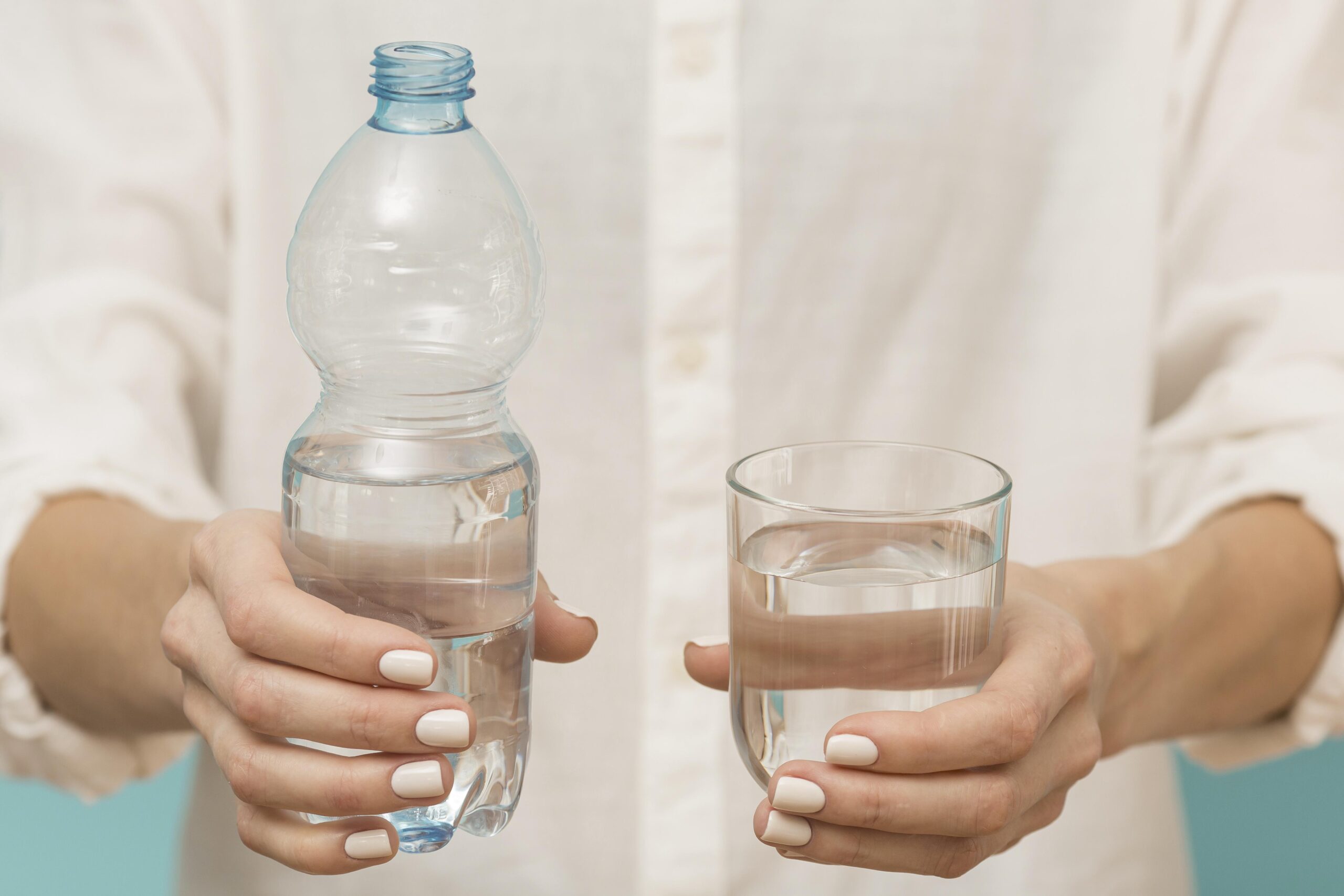
The plastic bottle arrives sealed.
That seal creates confidence. It looks controlled, familiar and ready to drink. In an office meeting room, hotel room or restaurant, nobody usually questions what is inside it.
Until someone asks:
Are there microplastics in bottled water?
The evidence-based answer is yes, researchers have detected microplastics in tested bottled-water samples. More recent work has also identified much smaller particles called nanoplastics.
That does not mean every bottle contains the same number of particles. It also does not mean science has settled the long-term health implications. Testing methods, particle sizes and results differ considerably between studies.
Still, the question matters.
For UAE businesses, it opens a wider discussion about water quality, plastic packaging, storage, recurring deliveries and whether a sealed bottle should automatically be treated as the best option.
At Sprudel, we help businesses replace single-use bottled water with on-site filtration, dispensing and reusable bottle systems designed for offices, hospitality venues, gyms and shared environments.
To discuss your site and current water setup, call +971 4 546 3988 or email hello@sprudel.life.
What Does the Research Actually Say?
A 2018 study tested 259 bottles from 11 globally sourced brands. Researchers reported evidence of microplastic contamination in 93 percent of the bottles tested. After accounting for possible laboratory contamination, the study found an average of 10.4 particles larger than 100 micrometres per litre, alongside many smaller suspected particles. (Frontiers)
A 2024 study published in the Proceedings of the National Academy of Sciences used a newer imaging method to examine three popular bottled-water brands. It detected approximately 110,000 to 370,000 plastic particles per litre, with most classified as nanoplastics rather than larger microplastics. The study was important because earlier testing methods could not reliably identify particles this small. However, it examined only three brands, so its findings should not be treated as a universal count for every bottled-water product. (PNAS)
In simple terms, better detection technology is allowing researchers to see particles that were previously difficult to measure.
That is why older and newer studies can produce very different numbers.
Should Businesses Treat This as a Health Emergency?
No. Panic is not useful, and the scientific evidence does not justify dramatic health claims.
The World Health Organization has confirmed that microplastics have been found in both bottled and tap drinking water. It has also stated that, based on the limited evidence available, microplastics in drinking water did not appear to present a proven health risk at the levels assessed. At the same time, WHO called for substantially more research, particularly on smaller particles and long-term exposure. (World Health Organization)
So the responsible position is balanced:
Microplastics have been detected.
Nanoplastics are increasingly measurable.
Exposure pathways are still being studied.
The complete health impact is not yet established.
For facility and procurement teams, this is not a reason to make medical promises. It is a reason to ask better technical and operational questions.
The Question Behind the Question
When employees ask, “Are there microplastics in bottled water?”, they may actually be asking several things:
- Is bottled water automatically cleaner than filtered water?
- What happens to bottles during transport and storage?
- Can our existing office cooler address small particles?
- What does the proposed filtration system actually reduce?
- Are we creating unnecessary plastic waste?
- Is there a better way to provide chilled water?
The wrong response is to say, “All filters solve the problem.”
They do not.
Different filtration technologies address different substances and particle sizes. The exact reduction performance depends on the filter media, micron rating, system design, installation and maintenance.
Before approving a system, ask for evidence relevant to the exact configuration being offered.
The Seven Questions Procurement Should Ask
1. What Does the Filtration System Specifically Address?
Avoid vague phrases such as “advanced purification” unless the supplier explains what they mean.
Ask for:
- Filtration stages
- Nominal or absolute micron ratings
- Independent testing or certification
- Substances the system is designed to reduce
- Replacement intervals
- Performance under commercial flow rates
Sprudel’s office sustainability guidance recommends selecting systems based on contaminants relevant to the site and maintaining clear filter-replacement schedules.
2. Was the System Chosen for the Building?
An office in a newer Business Bay tower may have different requirements from an older mixed-use property or a high-volume hospitality site.
The incoming supply, storage tank, internal pipes and final outlet should all be considered. A standard filter offered without any site discussion should raise questions.
3. Can It Handle Actual Footfall?
A technically strong filter can still create a poor experience if the system is too small.
Look at:
- Daily employees or guests
- Peak users per hour
- Meeting and event traffic
- Shift patterns
- Average refill-bottle size
- Future growth
A 40-person workplace with frequent client meetings may place more pressure on its system than a larger hybrid office.
4. What Is the Chilled Output?
In the UAE, temperature is part of water quality from the user’s perspective.
People may reject perfectly filtered water if it becomes warm after several consecutive refills.
Ask how many litres of chilled water the system can deliver per hour, how quickly it recovers and whether sparkling water remains consistently cold.
To discuss the capacity needed for your site, contact Sprudel on +971 4 546 3988.
5. Where Will the Tap or Dispenser Be Placed?
A filtration system cannot change behaviour when it is hidden in an inconvenient location.
The water point should be:
- Easy to see
- Natural to reach
- Suitable for reusable bottles
- Accessible for cleaning
- Away from narrow walkways
- Close enough to boardrooms or service zones
- Practical for maintenance
Poor placement often pushes people back towards bottled water because the old option remains easier.
6. What Is the Maintenance Plan?
Filtration performance depends on maintenance.
A filter left beyond its intended service life cannot be assumed to perform as designed. Facility teams should know who replaces filters, how usage is tracked, how the system is sanitised and what happens if servicing is delayed.
7. What Happens After Installation?
Weak after-sales support can undermine an otherwise suitable system.
Ask whether the provider offers:
- Preventive servicing
- Local technical response
- Filter and component availability
- Maintenance records
- Staff guidance
- Support if capacity needs change
At Sprudel, systems and service are planned together because commercial water infrastructure must work beyond installation day. Email hello@sprudel.life to discuss the support model for your environment.
Mini Case Scenario: The Office That Changed the Wrong Thing
A Dubai office became concerned after employees started asking whether bottled water contained microplastics.
Procurement responded by changing bottled-water brands.
The new bottles looked more premium, but the office still managed weekly deliveries, cases of bottled water, half-used meeting-room bottles and growing plastic waste. Nobody had reviewed the drinking water available in the building or compared point-of-use filtration options.
The office had answered a brand question, not a system question.
A better approach would assess the source water, test where necessary, understand daily demand and choose filtration based on evidence. Then the office could replace repeated bottle purchases with a controlled refill model.
How Sprudel Supports Different UAE Environments
Sprudel is not a bottled-water supplier. We provide on-site water systems built around the way each space uses water.
Sprudel Work
For offices, corporate pantries, boardrooms and professional environments requiring filtered still, chilled, hot or sparkling water.
Sprudel Work reduces reliance on single-use bottles by making filtered water available where teams and visitors already gather.
Sprudel Serve
For restaurants, cafés, bars and hotel F&B outlets that need still and sparkling water with commercial capacity and better presentation.
Sprudel Life
For gyms, wellness centres, residential communities and active shared environments where people regularly refill reusable bottles.
Sprudel Loop
For hotels and high-volume properties that want to filter and bottle water on-site using reusable, branded glass bottles. Sprudel Loop combines multi-stage filtration with UV-C purification in selected closed-loop configurations.
Explore the complete range at https://sprudel.awove.dev/, or call +971 4 546 3988 for a recommendation based on your business.
Common Mistakes Businesses Make
Replacing One Bottle Brand With Another
This changes the supplier but leaves the delivery, storage and waste model untouched.
Assuming Bottled Means Particle-Free
Research shows that tested bottled-water samples can contain microplastics and nanoplastics.
Assuming Every Filter Removes Everything
Filtration performance must be verified for the selected system and target particle size.
Buying Only on Price
A lower price may mean insufficient capacity, limited testing information or weak service support.
Ignoring Peak Demand
The system must perform during lunch, meetings, gym class changes or restaurant service, not only during a demonstration.
Forgetting Maintenance
Filters and purification components must be serviced according to an agreed schedule.
Making Unproven Health Claims
Businesses should discuss water quality and plastic reduction accurately, without claiming that a system prevents or treats medical conditions.
Quick Decision Guide
Choose an on-site filtration system when your business wants more control over the water served, fewer bottle deliveries and an easier reusable-refill model.
Before proceeding, confirm:
- Building and source-water conditions
- Relevant filtration performance
- Daily and peak footfall
- Chilled and sparkling output
- Suitable tap placement
- Maintenance responsibilities
- Local after-sales support
Sprudel can help review these requirements before recommending a system. Visit https://sprudel.awove.dev/ or send your site details to hello@sprudel.life.
Frequently Asked Questions
Are there microplastics in bottled water?
Yes. Multiple studies have detected microplastics in bottled-water samples, while newer research has also identified much smaller nanoplastics. The amount varies depending on the product, sample and testing method. (PNAS)
Are microplastics only found in bottled water?
No. Microplastics have also been detected in tap water, food and air. The presence of plastic particles is a wider environmental issue, not one limited to bottled water. (World Health Organization)
Are bottled-water microplastics proven to cause illness?
The long-term health implications are still being studied. WHO has stated that available evidence is limited and has called for more research rather than drawing definitive conclusions. (World Health Organization)
Can filtration reduce microplastics?
Certain properly selected filtration processes can reduce particles, but performance depends on the technology, particle size, flow rate and maintenance. Businesses should request evidence for the exact system being proposed.
How can I contact Sprudel?
Call +971 4 546 3988, email hello@sprudel.life, or visit https://sprudel.awove.dev/ to discuss on-site filtered water for your office, hotel, restaurant, gym or shared space.
Better Questions Lead to Better Water Systems
The most useful response to “Are there microplastics in bottled water?” is not fear.
It is scrutiny.
What evidence supports the system?
What happens before water reaches the glass?
Can the equipment handle real demand?
Who maintains it?
How much disposable plastic does the current model create?
At Sprudel, we help UAE businesses move from unquestioned bottle dependence to a more controlled on-site approach. The result can mean filtered water, fewer deliveries, less storage, reusable vessels and a water system designed around the people who use it.
To begin that transition, visit https://sprudel.awove.dev/, call +971 4 546 3988, or contact hello@sprudel.life.