

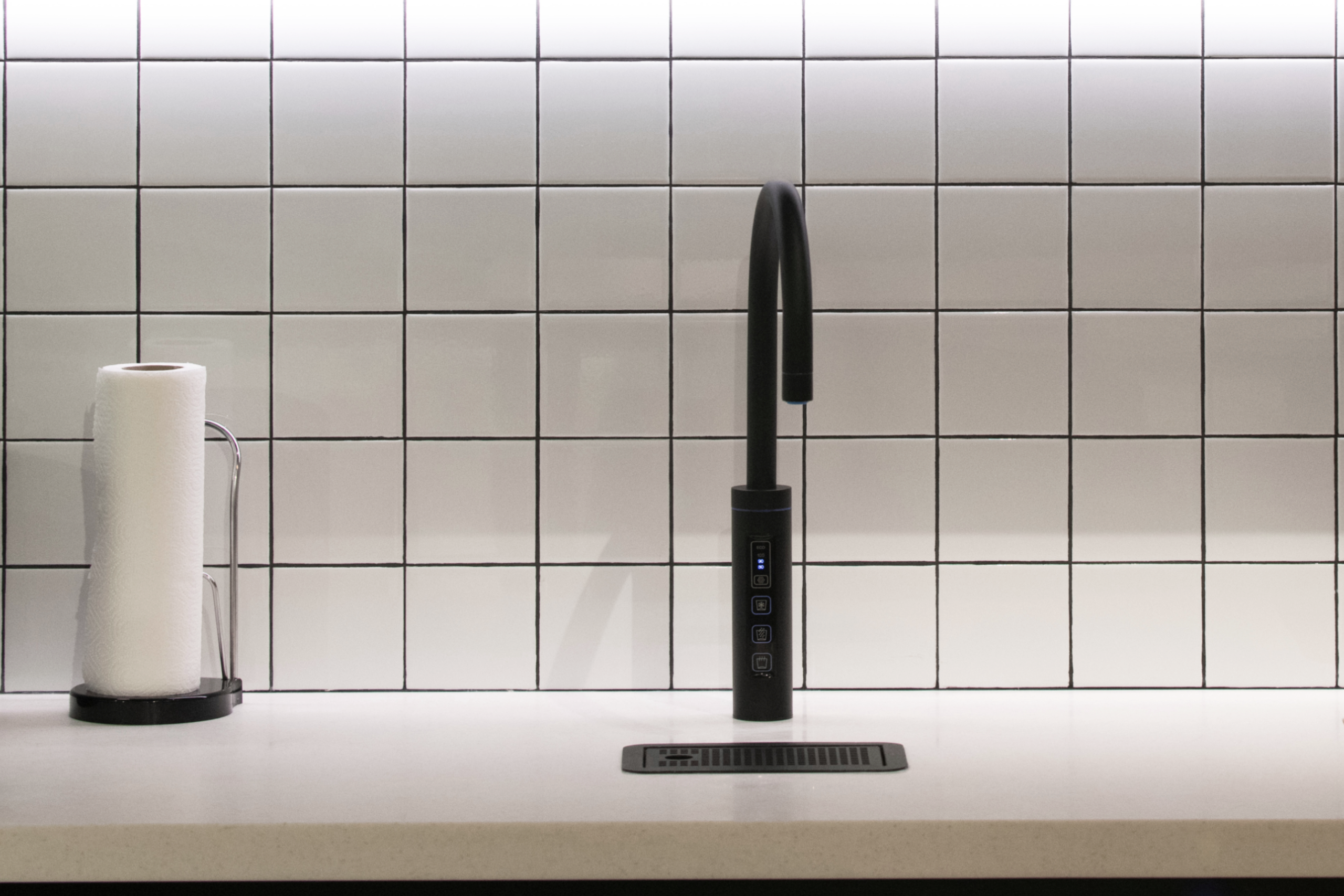
The question usually appears after someone takes a sip from the office pantry tap.
“Is tap water in Dubai safe to drink?”
One person says the water is treated. Another points at the building tank. Someone mentions old pipes. Procurement suggests buying a filter, while facilities starts comparing machines online.
The conversation quickly becomes more confusing than it needs to be.
The practical answer is this: Dubai’s public water supply is produced and monitored as potable water. DEWA operates an accredited laboratory and carries out extensive testing to verify that drinking water supplied through its network meets applicable quality standards.
But the water’s journey does not end at the public network.
Once it reaches a commercial building, it may pass through a storage tank, pumps, internal pipes and outlets before reaching the glass. DEWA’s current connection guidance makes customers and property developers responsible for the downstream pipework after the meter.
That is the part businesses need to assess before deciding whether filtration is necessary.
At Sprudel, we help offices, hotels, restaurants, gyms and shared spaces understand that full water journey, then choose an on-site filtration and dispensing system that fits the property.
For a site-specific discussion, call +971 4 546 3988 or email hello@sprudel.life.
The Better Question Is: What Happens Between the Network and Your Tap?
Asking “Is tap water in Dubai safe to drink?” is useful, but it is only the first question.
A better facilities question is:
What happens to the water between the municipal supply and the point where employees or guests drink it?
That journey may include:
- A building storage tank
- Booster pumps
- Internal plumbing
- Long pipe runs
- Low-use outlets
- Pantry taps
- Water coolers
- Existing filters
- Chillers and dispensers
Dubai Municipality publishes technical guidance covering unbottled drinking water and building water-system safety, while DEWA’s installation requirements place responsibility for internal systems downstream of the meter on the premises.
So, while the incoming municipal water is treated as potable, conditions inside a specific building can influence taste, temperature and confidence at the final outlet.
This is why businesses should not choose filtration based on fear, assumptions or a salesperson’s standard package.
Start with the building.
The Source-to-Glass Audit
Before buying equipment, facility teams should carry out a simple source-to-glass review.
Step 1: Check the Building Tank
Ask building management:
- When was the tank last cleaned?
- Is there a maintenance record?
- Who is responsible for inspection?
- Is the tank properly sealed?
- Have there been recent repairs or interruptions?
- Is the building following relevant water-system hygiene guidance?
A well-maintained tank is part of a reliable drinking-water system. A neglected tank cannot be fixed simply by placing a cheap filter under one pantry sink.
Step 2: Review the Internal Plumbing
Older pipes, rarely used outlets and long periods of stagnation may affect the water reaching individual taps.
Field insight: In many Dubai commercial offices, one pantry may be used constantly while a second pantry or meeting-room outlet remains unused for days. Water behaviour can differ between the two points even though they are inside the same workplace.
Ask whether there are unusual tastes, smells, visible particles or inconsistent pressure at specific outlets.
Step 3: Test the Water at the Point of Use
Do not rely only on what the water looked like at the source.
For a commercial decision, testing should be carried out at the outlet people will actually use. This is especially important for hotels, restaurants, healthcare environments, gyms and large offices.
The test results can help determine whether the business needs taste improvement, particle reduction, microbial control or another specific treatment approach.
Step 4: Match the Filtration to the Finding
Not every site needs the same filter.
Activated carbon, fine filtration, UV treatment and reverse osmosis perform different jobs. Installing the most complicated system does not automatically produce the best business outcome.
Sprudel uses multi-stage filtration and, in selected systems, UV-C purification to prepare mains-fed water for on-site dispensing or reusable bottling.
To discuss the correct approach for your site, send your building type, daily footfall and water requirements to hello@sprudel.life.
Filtration Should Improve Trust, Taste and Operations
Businesses often install filtration because employees or guests do not feel confident drinking directly from the tap.
That perception matters.
A system can help create a more controlled experience by filtering water at the point of use and dispensing it in the format people expect, such as:
- Ambient still water
- Chilled still water
- Hot water
- Cold sparkling water
- Refill water for reusable bottles
- Water for branded hotel glass bottles
Sprudel’s business solutions are designed to combine filtration with practical dispensing. Sprudel Work supports offices, Sprudel Serve supports restaurants and hospitality outlets, Sprudel Life supports gyms and active spaces, and Sprudel Loop supports closed-loop reusable bottling for hotels and high-volume properties.
Explore the options at https://sprudel.life/ or call +971 4 546 3988.
Six Mistakes Businesses Make Before Adding Filtration
Mistake 1: Choosing Only by Price
A low-cost filter may not match the building’s water conditions, daily use or service expectations.
Compare filtration stages, capacity, replacement schedule, certification, chilled output and technical support, not just the purchase price.
Mistake 2: Assuming Every Outlet Has the Same Conditions
Water at reception may not behave exactly like water in a distant pantry.
Test the point where the system will be installed.
Mistake 3: Ignoring Footfall
A 30-person office and a 300-person office should not use the same configuration.
Restaurants have service peaks. Gyms have post-class rushes. Hotels have room, F&B and event demand. Capacity must reflect real usage.
Mistake 4: Forgetting Chilled Output
In Dubai, filtered water that becomes warm after several refills will quickly generate complaints.
Ask how much chilled water the system can provide during the busiest hour, not only whether it has a cooling function.
Mistake 5: Poor Tap Placement
A technically convenient location can create queues or make refilling awkward.
Plan around staff movement, bottle size, meeting-room service, cleaning access and under-counter space.
Mistake 6: No Maintenance or After-Sales Plan
Filtration only works properly when filters, UV components and internal systems are serviced according to schedule.
Dubai Municipality’s guidance framework places clear importance on water-system hygiene and maintenance. (Dubai Municipality)
Confirm who services the system, how often, and how quickly support responds before approving installation.
Mini Case Scenario: The Office That Bought a Filter Before Checking the Tank
A Dubai office noticed an occasional taste from the pantry tap.
Procurement immediately ordered a countertop filter. It improved the taste for a while, but staff later reported the same issue again.
Facilities then reviewed the building records and discovered that the water tank maintenance needed attention.
The filter was not necessarily the wrong product. It was simply introduced before the full system was assessed.
The better sequence would have been: inspect, test, correct the building-side issue, then install point-of-use filtration for added control and a better drinking experience.
Quick Decision Guide
Choose Sprudel Work if:
You need filtered still, chilled, hot or sparkling water for offices, pantries, meeting rooms or client-facing workplaces.
Choose Sprudel Serve if:
You operate a restaurant, café, bar or hotel outlet requiring commercial still and sparkling water service.
Choose Sprudel Life if:
You manage a gym, wellness facility, campus or active shared space where people regularly refill bottles.
Choose Sprudel Loop if:
You need on-site filtration and reusable glass bottle circulation for a hotel or high-volume environment.
A mixed-use property may require more than one solution. Contact Sprudel on +971 4 546 3988 for help mapping the right system by area.
Frequently Asked Questions
Is tap water in Dubai safe to drink?
Dubai’s municipal water supply is produced as potable water and is extensively tested by DEWA. However, businesses should also consider the condition of their building’s storage tanks, internal pipes and final drinking outlets before making a site-specific decision.
Should every Dubai office install a water filter?
Not automatically. The decision should be based on point-of-use testing, building conditions, desired taste, employee confidence and operational needs.
Can filtration improve the taste of Dubai tap water?
Yes, an appropriately selected system can address taste, odour or particles, depending on what is identified during assessment.
Does filtered office water need regular testing?
Commercial systems should be maintained and monitored according to the provider’s schedule and applicable building or sector requirements.
How can I request a Sprudel assessment?
Call +971 4 546 3988, email hello@sprudel.life, or visit https://sprudel.life/ with your property type, location, footfall and preferred water options.
Do Not Filter the Question, Investigate It
The safest business decision is not to assume that all tap water is poor.
It is also not to assume that every tap inside every building delivers the same experience simply because the municipal supply is potable.
Start at the source. Check the tank. Review the plumbing. Test the outlet. Then select filtration based on evidence, usage and the experience you want to provide.
Sprudel helps businesses turn that assessment into a practical on-site water system, with filtered still, chilled, hot or sparkling water and ongoing service support.
For help planning the right solution after asking, “Is tap water in Dubai safe to drink?”, visit https://sprudel.life/, call +971 4 546 3988, or email hello@sprudel.life.